
Learning to Pay Attention

The walls are closing in or, if not the walls, then the groundwood sheets of newsprint, the pixilated screens of the news that never stops. Maybe this is the way we should feel at the end of eight years of presidency/puberty. It’s bad enough having teenagers in the house, but when the house is the White House…

(The Internal Editor is not happy with the presidency/puberty metaphor. “Far too mild,” he says, peering over my shoulder. “Don’t even associate the word ‘presidency’ with this miscreant. Compare him to an autocrat, a tyrant – Vlad the Impaler, something like that.” I think I’ve got a fine metaphorical theme about to unspool, but to placate the Internal Editor I agree to include some of his thoughts, at least parenthetically.)

The price of oil and therefore gas and therefore everything else, is running out of control. The economy crashes through one floor after another. On the news this morning, a couple of former Bear Stearns execs, accused of tripping the first in the series of fateful dominoes, were perp-walked through the streets of New York, the modern equivalent of the stock and pillory. Eighty years ago, at least stockbrokers had the moral fiber to throw themselves off ledges and crash into the streets below. Now they either wind up in rehab, church or a country-club federal prison. Or just pay a $50,000 fine after they assault flight attendants and take a crap on an airplane drink cart. (Yes, Gerard B. Finneran of Citibank and Trust Company of the West, we remember you.)
Continue reading »

What They Say About Paybacks

“Well, you know what they say about paybacks….” That’s not the kind of payback I have in mind, the payback that line refers to is more appropriately called revenge and is a dish best served cold.

I’ve been thinking about other paybacks this week. Tuesday, Senate Republicans blocked a bill that would have taken away tax breaks from the major oil companies, imposed a windfall profits tax on them and directed some of that money toward investments in alternative energy. The five major oil companies have made over 35 billion dollars so far this year. Yes, that’s billion with a “B.” The service rendered by the GOP is a payback for all those campaign contributions the oil companies have showered on them for the past decade. Good luck running on that in November, Republicans. You may run into a payback of the type alluded to in the first sentence above.

Republicans argued that passing such a bill would do nothing to lower the price of gas at the pump and they’re absolutely right. The bill would, however, take some of that money away from the oil barons and put it in service to the American public, so someday this price gouging may come to an end, because we will have developed other ways to live our lives than solely via an oil addiction.
Continue reading »
Ghost Town

There’s a difference, some parapsychologists say, between ghosts and spirits. Ghosts are the incorporeal essence of people who either don’t know they’re dead (which is why they often seem irritable) or who do know they’re dead, but cannot rest (perhaps due to some promise unfulfilled during life or because their bodies have not been properly interred.) (I write “some” parapsychologists, because “other” parapsychologists won’t even use the word “ghost.” Too imprecise, they say, preferring “apparition.”)

Spirits, on the other hand, know they’re dead and have no unfinished business, but choose to hang around Earth for reasons of their own. Perhaps you wake in the night to see your grandmother, who lives in distant state, standing by your bed, smiling at you. Next morning, you learn she died in the night. That’s a spirit.

All of this is prelude to saying I don’t know whether I’m a ghost or a spirit. Here’s the story: I lived in Washington, DC for eight years, from 1987 (late Reagan) to 1995 (mid-Clinton). Washington’s a four-year town. Many people come, stay for the length of one presidential term in office and move on. Others, like me, stayed eight years. Still others, 12 or 16. It seems like you get the chance to escape every four years and if you miss your opportunity, you’re stuck for another quadrennium. I know only one person who is an actual Washingtonian.
Continue reading »

The State of the Police State

Tuesday’s New York Times reported an outbreak of corruption among border guards along the U.S.-Mexican border. Although most of the corruption reported involves the smuggling of illegal aliens, similar corruption could introduce drugs, weapons and/or terrorists to the U.S. In short, the corrupt border agents do the opposite of what they were hired to do.

Should we be surprised? Not by the time we’ve finished the article. Here are a few data points:

One – the number of border guards will have doubled between 2001 and the end of 2009, from 10,000 to 20,000. As we’ve seen with the military, when we need to recruit larger numbers, we lower our standards. The Border Patrol is finding that criminals are applying for jobs with the intention of subverting the system and using their authority to enrich themselves through smuggling.

Two – When the Department of Homeland Security was created in 2003, the internal affairs units at Customs and Border Protection – the police who police the police – was disbanded. So just as you’re doubling the size of the border guards, you send the message that you’re not even going to look for corruption. Internal affairs has now been reconstituted, but it’s hopelessly backlogged, so 155 retired criminal investigators have been hired to perform background checks on new border guards.
Continue reading »

M&M Enterprises

When I was a young man, I read (as every young person should) Joseph Heller’s “Catch-22,” a novel about the absurd bureaucracy of war and the misery it wreaks on those caught within it.

The most absurd character in the book is Milo Minderbinder, who – at least initially – runs the mess hall. A true entrepreneur, Milo steals supplies from the army and sells them on the black market. He justifies this by telling the servicemen he’s cheating that they will all benefit from his larceny. He issues “shares” in M&M Enterprises. The Ms stand for Milo and Minderbinder, but he put an ampersand between them to “demonstrate” that the company will benefit all. “What’s good for M&M Enterprises is good for the country,” he tells the airmen who complain that he’s ripping them off and endangering their lives by selling the safety equipment from their planes. (Does any of this sound familiar?)

By the end of the book, Milo has misappropriated an entire squadron of planes and is bombing his own airbase, having signed a contract with the Germans to do so. It’s absurd, right? Mr. Heller, like many novelists, uses exaggeration to allow readers to see our own society in a new light.
Continue reading »

Things I Never Learned in School

History question: In what year did an American woman first cast a vote for president? The standard answer is 1920, after the passage of the Nineteenth Amendment to the Constitution granted suffrage to American women. But it’s wrong.

The first presidential ballot was cast by a woman in the election of 1872. The woman, unsurprisingly, was Susan B. Anthony. The place she cast her ballot was my hometown, Rochester, New York.

I learned this a few years ago and immediately wondered, “Why was I not taught this in school?” Yes, I heard Ms. Anthony’s name when I was in grade-school civics class, probably the same way every other student of my era heard it, but those other students didn’t live in the same city as Ms. Anthony.

In the latter half of the 19th century, the area between Rochester and Syracuse was a hotbed of women’s activism. The first American women’s rights convention was held in Seneca Falls, NY in 1848. The second was held in Syracuse in 1852. In the election of 1872, Ms. Anthony walked into a polling station, filled out a ballot and deposited in the box. As there was no way to determine which ballot was hers, it was counted along with the rest. (That night, she wrote to Elizabeth Cady Stanton that she voted a straight Republican ticket. Ulysses Grant was the presidential nominee.)
Continue reading »

Still Doubting?

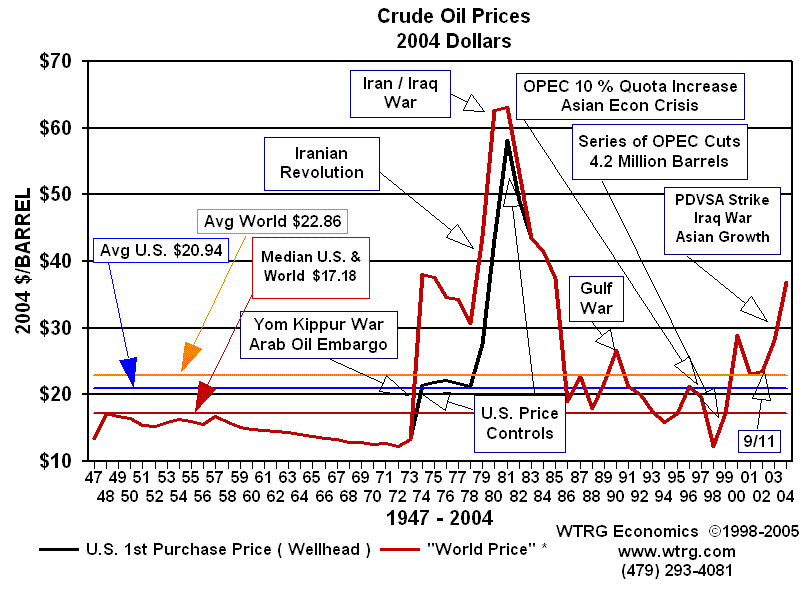
One of my more frequent and controversial topics of comment is peak oil. It was nine years ago this week that I first wrote of the phenomenon. For those of you who may have missed all those commentaries, here’s a quick recap.

“Peak oil” is the term used to describe the situation that will occur (or is occurring) when global demand for oil exceeds global production. It will occur (or is occurring) when either our total oil reserves decline precipitously or when demand rises so fast that new production cannot be brought on line fast enough. We won’t (or didn’t) have the capacity to recognize the onset of peak oil until several years after it has (or had) occurred.

In that 1999 piece, University of Colorado geologist Albert Bartlett predicted (to Congress, no less) that the global oil peak would arrive in 2005. Geologist Ken Deffeyes of Princeton predicted in 2004 that the global oil peak would be reached in mid-December 2005. Were they right? (Looking at this graph, I’d say yes.)
Continue reading »